
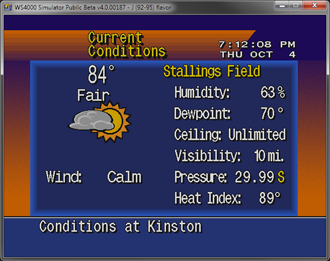
A summary of the latest weather observations from your local observing station.
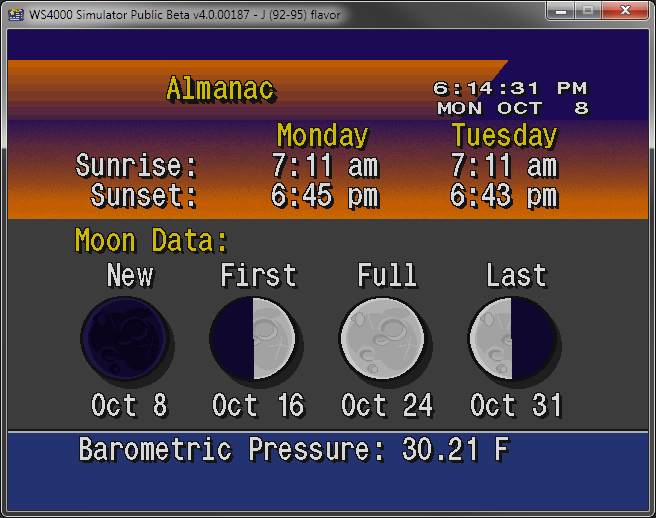
Upcoming sunrise, sunset, and moon phase times for your chosen hometown.
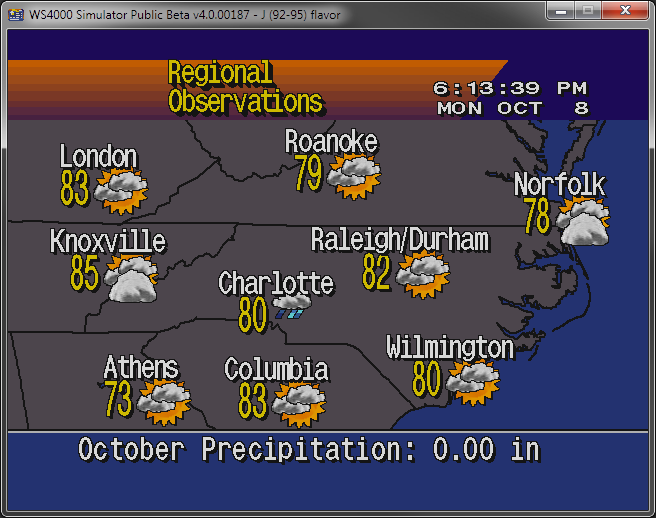
Current weather conditions and temperatures across your chosen region.
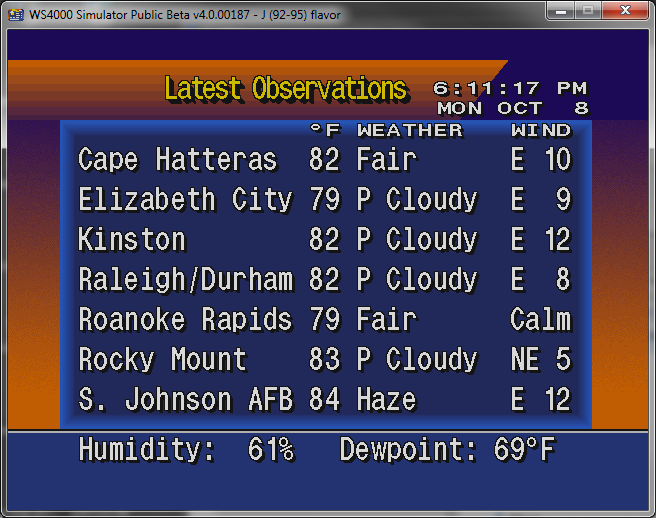
A brief text-based summary of weather conditions at seven observing stations in your area.
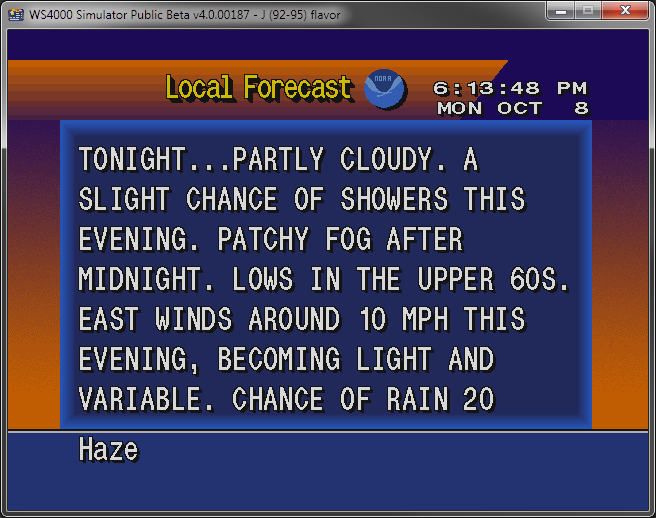
Text-based National Weather Service forecast of the weather conditions in your hometown over the next day and a half.
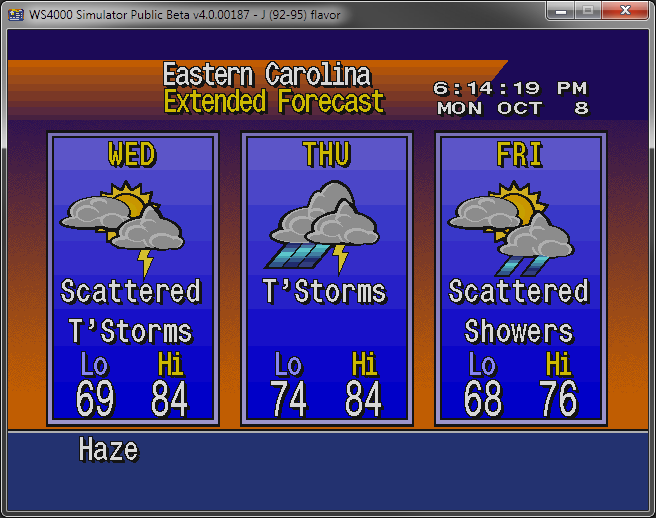
A three day graphical forecast for your hometown generated from digital National Weather Service forecast grids.
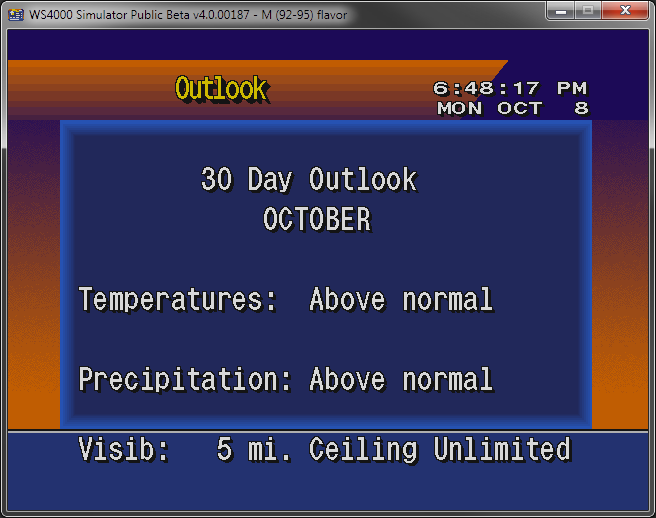
A text-based, long range forecast for your region for the next 30 days derived from digital data from the Climate Prediction Center.
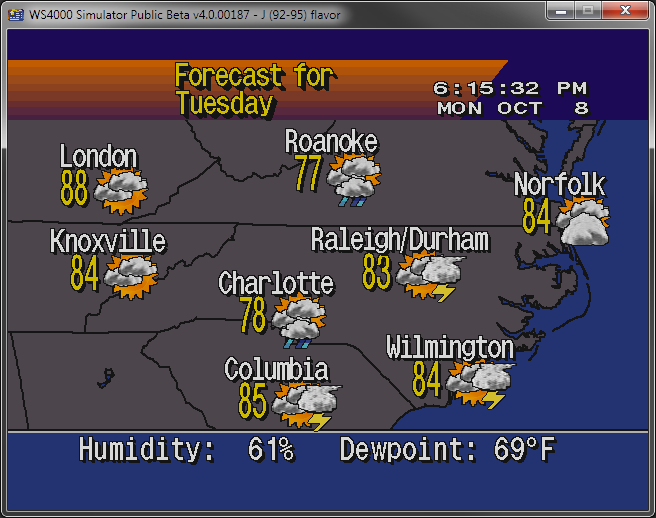
A graphical map-based forecast for your region generated from digital National Weather Service forecast grids.
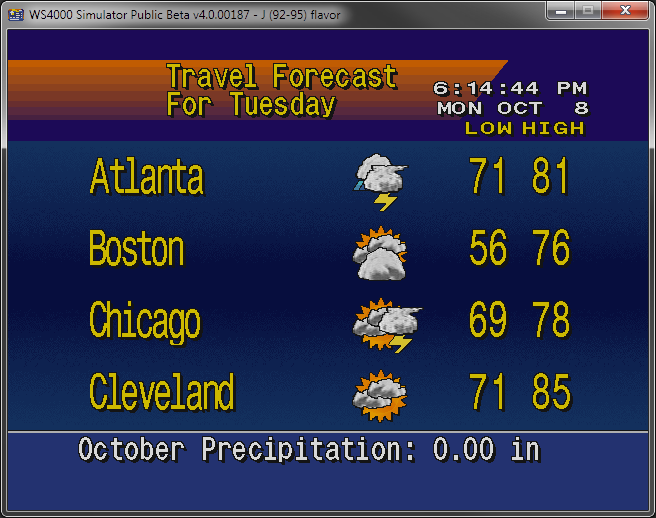
A graphical forecast with high and low temperatures for 24 cities across the nation generated from digital National Weather Service forecast grids.
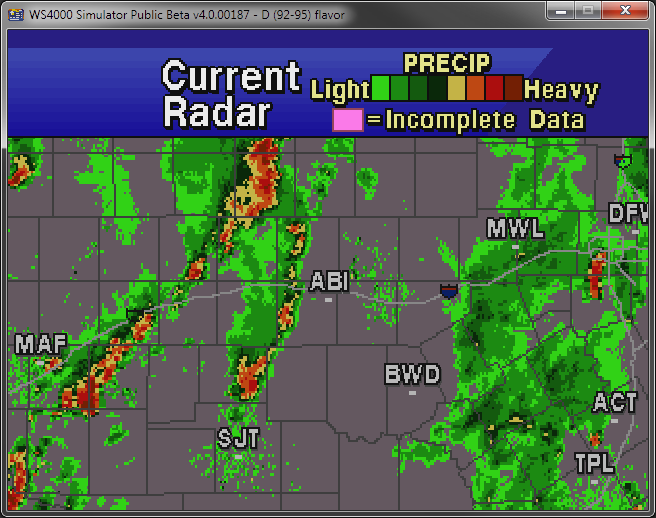
Shows precipitation in your local area, in both static (Current Radar) and animated (Local Radar) form.
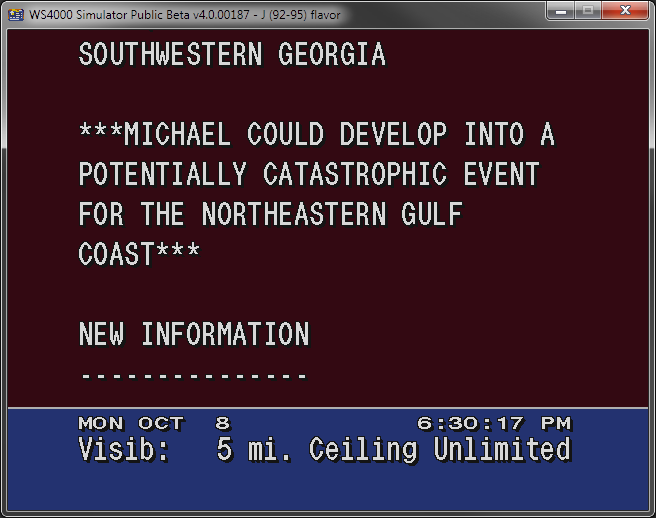
For important National Weather Service issued statements, watches, and advisories.
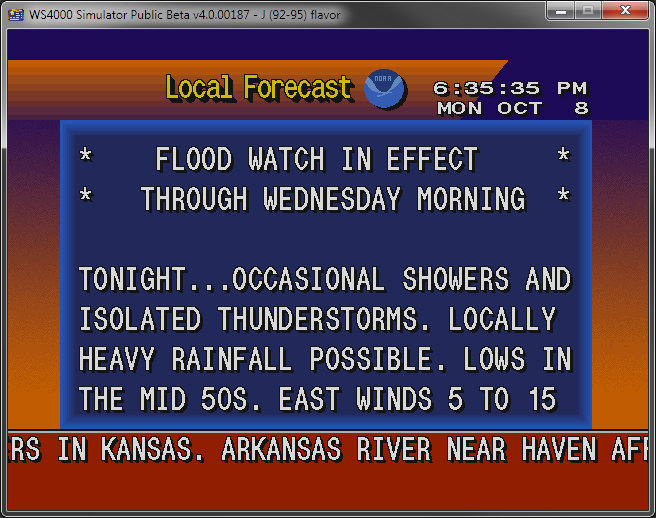
For critical National Weather Service warnings which highlight an imminent threat to life and property.
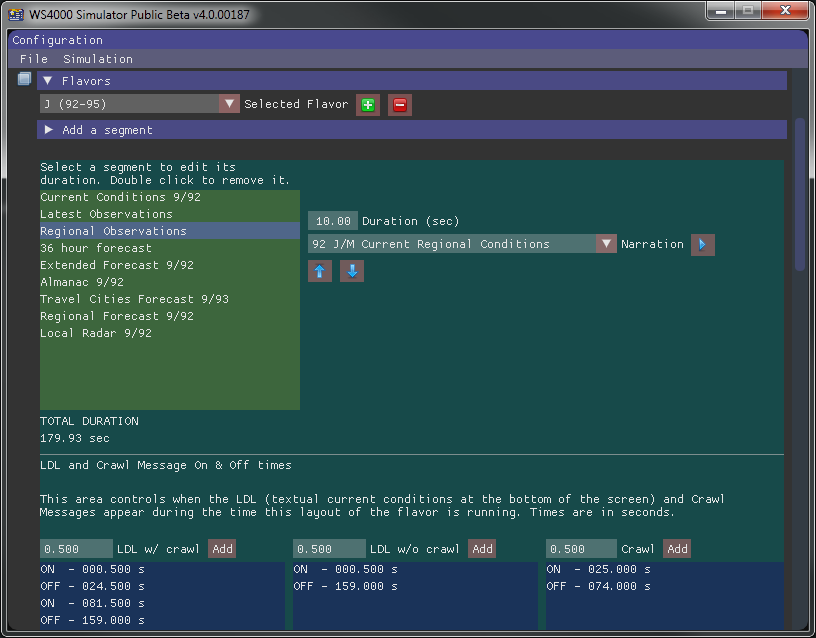
Create your own lineups (flavors) or choose from dozens of built-in ones. Control ordering, time on screen, narration type. Fine-tune LDL behavior. You can even define exactly how fast the local radar frames animate.
The simulator incorporates the FMOD sound engine, a proven audio solution with a long history of being utilized in several AAA game titles. With the FMOD sound engine, a variety of non-DRM protected codecs are supported for your music files.
Detailed customizations are possible, including millisecond precision on when a song starts, associating a song with a flavor, and even having a different song file play during Vertical Bulletin Scroll advisories.
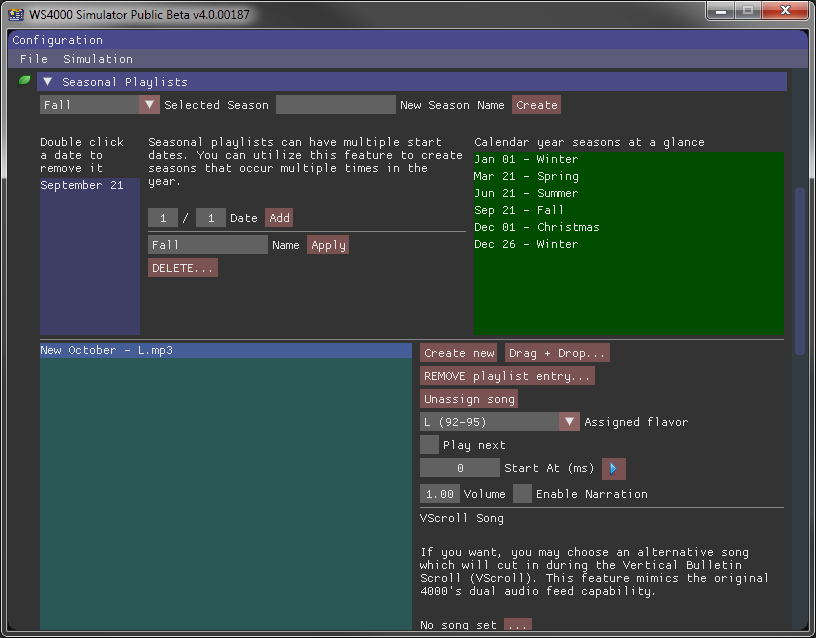
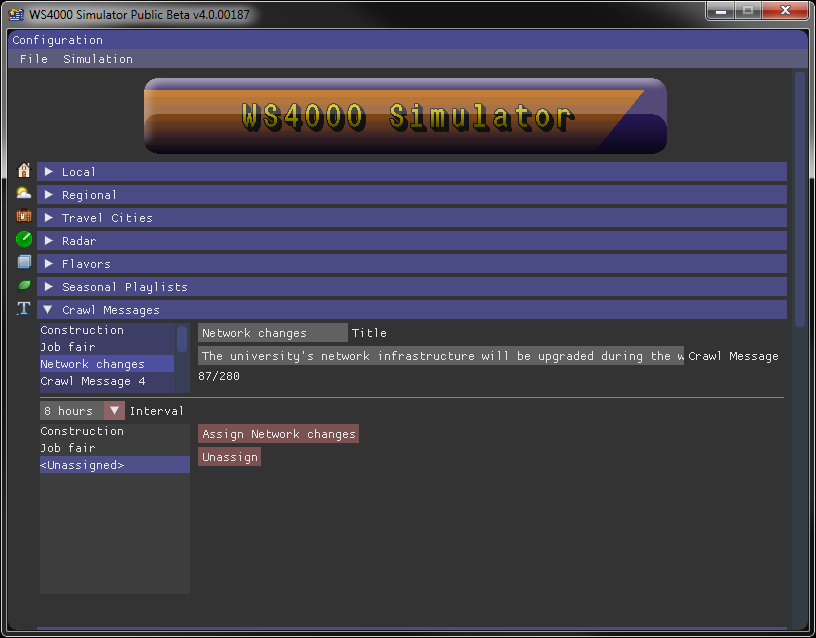
You can even add your own messages to be scrolled on the LDL, just like the 4000 did. Ten different crawl messages can be stored along with the ability to schedule them from 15 minute display intervals up to 24 hours.
The configuration and time scheduling functionality for crawl messages was modeled precisely after the 4000's.
Files of this nature generally serve three primary use cases in the Android ecosystem: 1. Custom ROM Localization & Language Corpora
| Part | Meaning | |------|---------| | | Internal code name for a device. Most famously, the Lenovo Tab P11 Plus (codenamed Picasso ) or potentially an early Huawei tablet. | | 10 | Likely refers to Android 10 (Q) . | | eng | Engineering build – not a user release. This is a debug build used by developers or testers, often with root access and verbose logging enabled. | | heavy | Suggests a large, feature-packed, or resource-intensive version. Could include extra debugging tools, Google apps (GApps), or vendor bloat. | | .apk | Android Package Kit – an installable app file. |
The library is extremely lightweight (around 120KB) and has been widely adopted by developers for its reliability and efficiency.
: Likely refers to the hardware model or a specific version of the "Picasso" board. picasso10-eng-heavy.apk file
Before diving into the specifics of the file, it is essential to understand the format.
If the file is a genuine engineering application meant for a specific hardware platform (like a particular MediaTek tablet or phone), forcing its installation on an incompatible device can cause severe software conflicts. This can result in continuous application crashes, system lag, UI freezing, or a "bootloop" where the device refuses to start up. 3. Compromised System Privileges
Downloading APKs from third-party sites exposes your device to: Data Theft : Potential for credential harvesting. System Instability : Unoptimized code that can cause battery drain or crashes. Legal Risks Files of this nature generally serve three primary
No. The manifest targets Android 10. On newer Android versions, permission changes and scoped storage will break its core functionality.
Recently, queries regarding a specific file named have surfaced across tech forums and search engines. If you have encountered this file on your device, within a download folder, or on a third-party website, it is crucial to understand what it represents, where it originates, and how to handle it safely. What is an APK File?
In short, the appears to be an engineering‑grade, Android‑10‑based, heavy‑weight system utility intended for a tablet or large‑screen device codenamed “Picasso.” | | 10 | Likely refers to Android 10 (Q)
Because this is an engineering ("eng") build, it is not optimized for everyday consumer use. Installing it can cause boot loops, application crashes, or severe battery drain.
Before installing any APK with a non-standard name like "picasso10-eng-heavy.apk," you should take the following precautions: Scan the File: Upload the APK to VirusTotal to check for embedded malware or trojans. Verify the Source: Only download such files from reputable communities like XDA Forums where other users can provide feedback and verification. Check Permissions:
Downloading and installing files like picasso10-eng-heavy.apk from third-party sources carries significant risks.
– Upload the file to VirusTotal . Even then, note that “eng” builds may trigger false positives for hacktools.